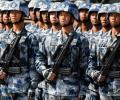
With the Indian Army having blocked the PLA several kilometres inside India, hundreds of soldiers from both sides remain in a tense face-off.

The Indian Army has shown it can face down the PLA, but is too often held back by a political leadership that lacks boldness, asserts Ajai Shukla.
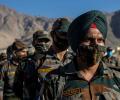
The decisions were mentioned in a joint statement issued by the two armies late Tuesday, a day after the sixth round of Sino-India Corps commander-level talks that lasted for 14-hours.
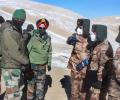
"The meeting thus did not result in resolution of the remaining areas," the Army said in a statement.

The sources said the Indian Army has been on a very high level of alert and is ready to deal with any eventuality in the area.

"When we have something to share, we will share. Discussions are ongoing," External Affairs Ministry Spokesperson Anurag Srivastava said replying to a volley of questions on whether India and China are working on specific proposals to resolve the over six-month-long row in eastern Ladakh.

The meeting started at around 11.30 am at Moldo on the Chinese side of Line of Actual Control (LAC) opposite Chushul to defuse the tensions in Eastern Ladakh sector due to Chinese military build-up, the sources said. This is the second meeting between the two corps commanders.
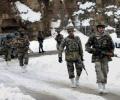
The two sides have already held seven rounds of Corps Commanders level talks to discuss the entire issue of transgressions in the Eastern Ladakh sector.

'The Chinese staying put in Pangong Tso, and creating a buffer zone on Indian territory in other areas,' a senior serving general tells Ajai Shukla.

The visit is also aimed at boosting morale of the army personnel engaged in the seven-week bitter border faceoff with the Chinese troops in the region, sources added.

The meeting will take place in Chushul sector on the Indian side of Line of Actual Control.

'India's behaviour violated agreements...It's a serious military provocation'

The meeting came after the Indian Army thwarted an attempt by the Chinese Army to transgress into Indian areas near the southern bank of Pangong Tso near Chushul in Ladakh on the intervening night of Saturday and Sunday.

The move comes amid hectic diplomatic manoeuvring between the two countries over a host of issues like Nuclear Suppliers Group and designation of Masood Azhar as a terrorist by the United Nations.
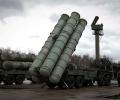
RInstead of disengagement, the Indian and Chinese armies have deployed an estimated 35,000 to 40,000 soldiers each along the LAC. The PLA has deployed S-400 air defence missiles to neutralise the IAF's advantage in air power
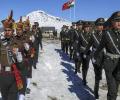
In a joint statement, the two armies said it was agreed to earnestly implement the important consensus reached by the leaders of the two countries and ensure that the frontline troops exercise restraint and avoid misunderstanding and miscalculation.
As per the sources, the discussions between the two sides include pulling back tanks and armoured vehicles from their present positions, and some development in this regard is likely to take place in the next few days.

'Rezang La was a unique battle.' 'It was not a large scale battle like the Battle of Kohima which involved a large number of troops.' 'Here there was just a company that fought it out till the last man.'
This is the third round of Corps Commander-level talks being held. The first two rounds had taken place in Moldo on the Chinese side of the LAC.

The Indian Army has occupied several key heights in the strategically located Rezang-La and Reqin-La areas on the southern bank of the lake since the end of August.
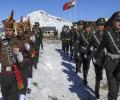
The focus of the deliberations was on finalising modalities for disengagement of troops in eastern Ladakh.

The last round of Corps Commander-level talks had taken place on October 12 but there was no breakthrough on the disengagement of troops from the friction points.
The seventh round of military talks between India and China held on Monday was "positive and constructive", and both sides agreed to earnestly implement the understanding reached by their leaders to not turn differences into disputes, a joint statement by the two armies said on Tuesday.
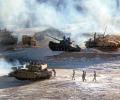
'India cannot allow Beijing's policy of stabilising and destabilising the border at will to perpetuate its own ends.' A riveting excerpt from Manish Tiwari's 10 Flashpoints; 20 Years National Security Situations That Impacted India.

The Indian Army on Friday strongly insisted on early disengagement of troops by China from all the friction points in eastern Ladakh at the eighth round of corps commander-level talks between the two sides that primarily focused on a roadmap for restoration of peace and tranquillity in the region, according to people familiar with the developments.
Sources said the process of disengagement along the Line of Actual Control is "complex", and in such a context, speculative and unsubstantiated reports need to be avoided.
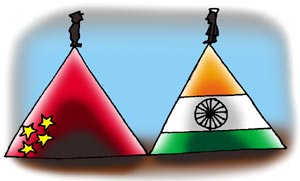
A new Border Personnel Meeting point was on Saturday operationalised at Daulat Beg Oldie along the Line of Actual Control in Ladakh sector, which would serve as the northern-most meeting point between armies of India and China.
Sources said India will not lower its guard and will maintain the current state of very high-level of combat readiness in eastern Ladakh till there are visible changes in the ground situation.

'The use of military power to settle disputes is not always preferred and is the last preferred option, but it certainly remains an option.'
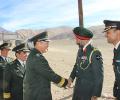
Amidst reports of Chinese incursions, the Peoples Liberation Army and the Indian Army on Sunday decided to uphold treaties and agreements signed between the governments of the two sides to maintain peace and tranquility along the Line of Actual Control.
The day-long exercise held "is part of the ongoing initiatives being taken by India and China to ensure greater interaction between troops stationed along the Line of Actual Control.

Army Spokesperson Colonel Aman Anand said troops from China's People's Liberation Army (PLA) 'violated' the consensus arrived at during military and diplomatic engagements on the ongoing standoff in eastern Ladakh, and carried out provocative military movements to change the status quo.

'Those who say that conventional war is a thing of the past or that war is not an option, or that diplomacy alone can prevent war -- are wrong and we see that in Ukraine.'

It is learnt that the Indian delegation insisted on a time-bound implementation of the agreement finalised during the extensive talks between External Affairs Minister S Jaishankar and his Chinese counterpart Wang Yi in Moscow on September 10 on the sidelines of a Shanghai Cooperation Organisation(SCO) meet.

Chushul and Depsang are not vital in this game of Chinese checkers, the Indian Ocean Region is. Keeping our maritime prowess restricted has to be a key Chinese strategic interest and it would appear that the LAC affair has helped China achieve its aim, points out Vice Admiral Premvir Das (retd).
'Today, our vast green pastures where local herders used to take their cattle to graze have been taken over by the Chinese.' 'The people in the Galwan Valley have lost their lands where their cattle used to graze.'

The MEA spokesperson further said the actions and behaviour of the Chinese side since earlier this year along the LAC have been in "clear violation" of the bilateral agreements and protocols concluded between the two countries to ensure peace and tranquility on the border.

Chinese army personnel on Monday joined their Indian counterparts in celebrating the country's Independence Day at Chushul in Leh area, a defence spokesman said in Srinagar.\n\n

It is the first highest level face-to-face meeting between the two sides after the border row escalated in eastern Ladakh in early May.

Indian Army officers are convinced China is maintaining the pretence of dialogue and negotiations in order to create the opportunity to occupy more Indian territory. Senior Indian planners apprehend this might be a Chinese ploy to divert attention from Depsang, in Northern Ladakh, which might be China's actual target.
 © 2026 Rediff.com - Advertise with us - Disclaimer - Privacy Policy - Sitemap - Feedback - About us - Terms of use - Grievances